Project engagement
AI product prototypes built on production patterns
A working AI prototype in weeks: agents, tool calling, real chat UX. Validate the idea before you commit a roadmap to it.
Built on patterns from Iridium, my AI app starter kit, and Sprocket, a 12-agent personal assistant.
Who this is for
- Founders with an AI product idea who need something real to show users or investors
- Product teams who need to know if an agent workflow actually fits before staffing it
- Companies whose AI demo is a slide deck and needs to become a working thing
- Teams that tried building on raw API calls and hit a wall on tool calling or state
What you get
- A working prototype users can touch: real model calls, real data, deployed at a URL
- Agent and tool-calling architecture that maps to how the production version would work
- Chat and generative UI that feels designed, not dumped on screen
- Model and provider recommendation based on your workload, with costs estimated
- Clean TypeScript codebase your team can extend into production
- A written readout: what the prototype proved, what it did not, and what production takes
What an engagement looks like
Agent workflow prototype
An agent that does a real job in your domain with tool calling against your actual APIs, so you can judge usefulness instead of guessing.
AI feature inside your product
A designed, working AI feature (assistant, summarization, generation) integrated against a copy of your real product surface.
Investor-ready demo
A polished, deployed demo that shows the core magic reliably. Built honest: the readout is clear about what is real and what is staged.
How it works
- 01
Scope call (free)
We define the one question the prototype must answer and the smallest build that answers it.
- 02
Architecture sketch
Agents, tools, models, and data flows on one page. You know what is being built and why before the build starts.
- 03
Build in weekly demos
The prototype grows in weekly deployed checkpoints. You steer while it is cheap to steer.
- 04
Readout and handoff
Working prototype, the codebase, and a straight readout on what production requires. No demo theater.
Proof

Iridium
Ship AI-powered apps in days, not months. Iridium gives you authentication, an agentic AI chat system with tool calling, Stripe payments, and production-ready patterns so you can focus on what makes your product unique.
Read the case study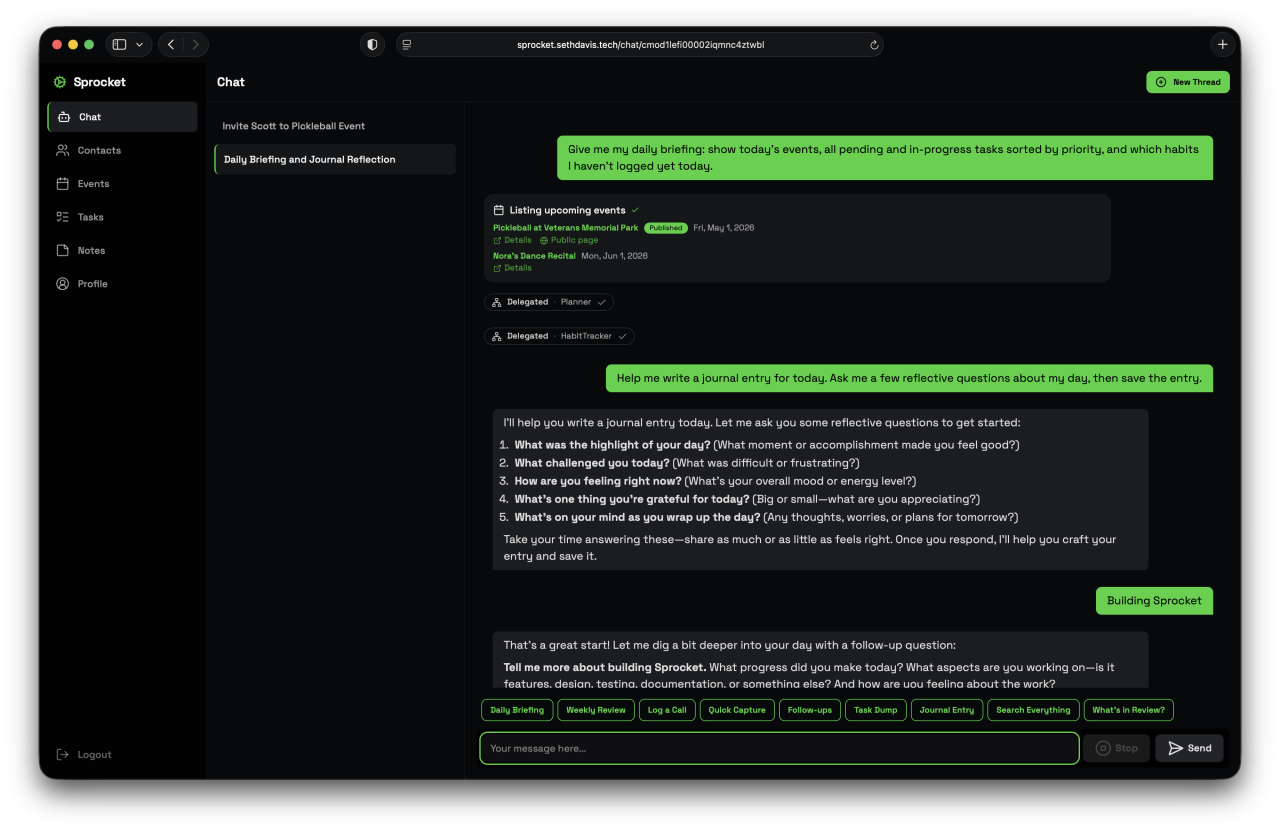
Sprocket
A personal AI assistant powered by a supervisor and 12 specialized sub-agents covering relationships, journal, notes, tasks, calendar, habits, finance, and weekly reviews, all in one chat.
Read the case study
AI Maniacs
Free AI education platform. Fundamentals through agent workflows, built to keep up with how fast the field moves.
Read the case studyCommon questions
Prototype or production?
Prototype, built on production patterns. It is real code with real architecture, so nothing has to be thrown away, but the goal is answering "should we build this" in weeks rather than shipping to thousands of users.
Which models and providers do you use?
Claude is my default for agentic work and tool calling. The recommendation depends on your workload, latency, and budget, and the prototype makes switching providers cheap to test.
What happens to the code?
It is yours. Clean TypeScript in your repos, documented well enough that your team or a future contractor extends it without archaeology.
What about our data?
Prototypes run in your accounts against the data you choose to expose. Nothing gets used to train anything, and provider data policies are part of the model recommendation.
Start the conversation
The fastest path is a free 30-minute scope call. Prefer to write it out? Use the form and I'll reply within one business day.